


Composite or Timber Decking? How to Choose for a Scottish Garden
This is a guest post by Crowstep Digital, a web design and local SEO agency based near Stirling that works with trade businesses across Central Scotland.
A new deck can turn a muddy corner of the garden into the most used “room” of the house. Before anyone picks up a saw, though, there is one question nearly every homeowner asks: should it be composite or timber? Both make good decks. Both can also disappoint if they are chosen for the wrong reasons or fitted on the wrong base. The honest answer depends on your garden, how you live in it and how much time you want to spend looking after it.
This guide does not try to declare a winner. It sets out the differences that matter in a Scottish garden, where decks deal with plenty of rain, short winter days and shaded corners that rarely dry out, so you can have a better conversation with your fitter.
What is the difference?
Timber decking is made from real wood. In the UK that usually means pressure-treated softwood, although naturally durable species such as larch and various hardwoods are also used. It has genuine grain, it can be cut and shaped on site, and it can be sanded and re-treated over its life.
Composite decking is a manufactured board, usually a blend of wood fibre and plastic, often with recycled content. Many modern ranges are “capped”, meaning the core is wrapped in a harder outer shell that resists staining and fading. Boards come in set colours and finishes, and they are designed to look consistent from one board to the next.
How Scottish weather changes the decision
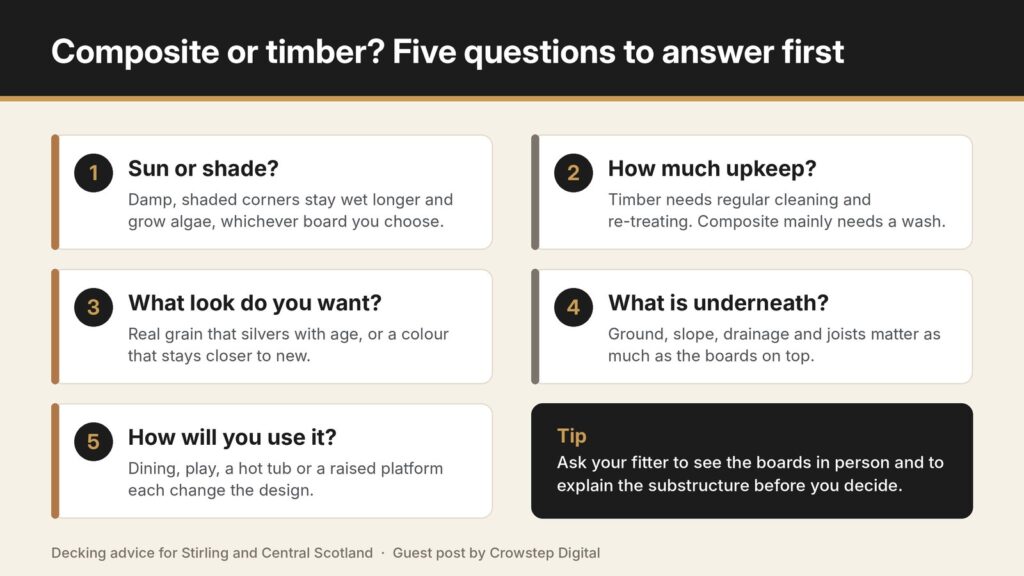
Rain is not really the enemy of a well-built deck. Standing water is. Leaves that collect between boards, a deck laid tight to the ground with no airflow, or a shaded spot under trees that stays damp all winter will cause problems whatever the boards are made of.
- Algae and grip: any deck can become slippery in a damp, shaded spot. Regular brushing and washing make a big difference with both materials. If grip matters, for example by a back door or on steps, ask about grooved or textured boards and how the manufacturer recommends keeping them clean.
- Movement: timber swells and shrinks as it wets and dries. Composite boards expand and contract with temperature. In both cases the fitter needs to leave the right gaps and follow the manufacturer’s fixing guidance.
- Drying out: a deck needs air moving underneath it. Good ventilation and drainage help the frame last, and that matters as much as the choice of boards.
Upkeep: be honest about your weekends
This is often where the decision is made. A timber deck needs regular cleaning, and most owners re-oil, stain or treat it from time to time to keep its colour and protect the surface. Left alone, timber weathers to a silvery grey, which some people love and others do not. Damaged boards can usually be sanded or swapped individually.
Composite is not maintenance-free, but the work is mainly cleaning. A brush and a wash, following the manufacturer’s care instructions, is usually what is needed. There is no oiling or staining. The trade-off is that you cannot sand out a deep scratch in the same way, so it is worth asking how a board would be repaired or replaced if it were damaged.
Looks, feel and how you will use the space
Timber feels natural underfoot and suits cottage gardens, older properties and anyone who likes the idea of a deck that changes character over time. Composite suits people who want a crisp, even finish that stays closer to its original colour, and it is available in greys, browns and charcoals that pair well with modern houses and glass balustrades.
Think too about what the deck is for. A dining area, a play space for children, a raised platform over a sloping garden or a base for a hot tub each bring different needs. Heavy loads and raised decks need careful structural design, and stairs and edges need to be safe in the wet.
The part nobody sees: the substructure
The boards get all the attention, but the frame underneath decides how long a deck lasts. Ask your fitter how the ground will be prepared, what the joists will be made of, how far apart they will be and how the deck will drain and ventilate. Composite boards usually have specific joist spacing and fixing requirements set by the manufacturer, and following them can be a condition of the product warranty. A good fitter will explain this without being asked.
If the deck will be raised, sit close to a boundary, or the property is listed or in a conservation area, check whether you need planning permission or a building warrant before work starts. Your local council, which for much of this area is Stirling Council, can advise.
Comparing quotes fairly
Composite boards generally cost more to buy than standard treated softwood, but the full picture includes groundwork, the frame, fixings, steps, edging, balustrades and any lighting. When you compare quotes, make sure each one describes the same deck: the same size, the same board range, the same substructure and the same finishing details. A cheaper price sometimes means a lighter frame or fewer details, so ask.
Choosing a fitter you can trust
Most people start by searching for decking fitters near them. The businesses that appear at the top of Google and Google Maps are not automatically the best, but a strong local listing tells you a few useful things. Look for a real address and service area, recent reviews that describe actual jobs, and photographs of finished decks rather than stock images. Those are the same trust signals that we help local trades get right as a local SEO agency in Stirling, and they are just as useful to you as a homeowner checking out who to invite round to quote.
When the fitter visits, a good one will ask about the ground, the drainage, how you use the garden and what you want it to look like in years to come. They should be happy to show you board samples, explain the substructure and talk through the upkeep honestly, whichever material you lean towards.
So, composite or timber?
Choose timber if you love natural wood, want the flexibility to sand and refinish it, and do not mind setting aside time to clean and treat it. Choose composite if you want a consistent look with less routine upkeep and are happy to invest more in the boards. In either case, put as much thought into the frame, the drainage and the fitter as you do into the boards.
Planning a deck in Stirling or Central Scotland?
We supply and fit both composite decking and timber decking for homes in Stirling, Dunblane, Bridge of Allan and across Central Scotland. If you are weighing up the options for your own garden, get in touch with a few details and photographs of the space, and we can talk you through what would suit it.